

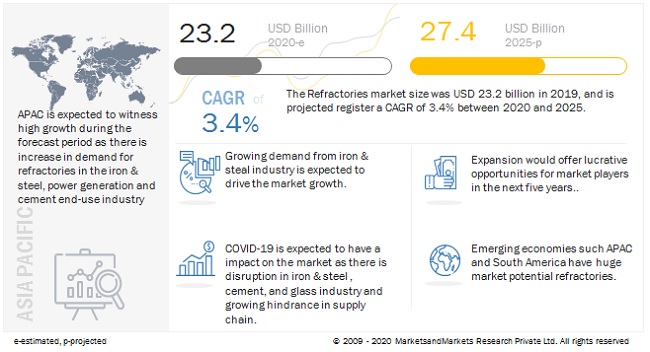
The Refractories market size is expected to grow at a CAGR of 3.4%, by value, during the forecast period. The market is estimated to be USD 23.2 billion in 2020 and is projected to reach USD 27.4 billion by 2025. The driving factors for Refractories market is its growing demand from iron & steel industry.
To know about the assumptions considered for the study, Request for Free Sample Report
COVID-19 Impact on the Refractories Market
The global Refractories market includes major Tier I and II suppliers like as Saint-Gobain (France), RHI Magnesita (Austria), Corning Incorporated (US), Morgan Advanced Materials (UK), and Shinagawa Refractories (Japan). These suppliers have their manufacturing facilities spread across various countries across Asia Pacific, Europe, North America, South America, and Middle East & Africa. COVID-19 has impacted their businesses as well.
These players have announced the suspension of production due to the lowered demand, supply chain bottlenecks, and to protect the safety of their employees in the US, France, Germany, Italy, and Spain during the COVID-19 pandemic. As a result, the demand for refractories is expected to decline in 2020. Manufacturers are likely to adjust production to prevent bottlenecks and plan production according to demand from tier 1 manufacturers.
Refractories: Market Dynamics:
Driver: Increase in infrastructural development in emerging countries
Growing urbanization and industrialization, especially in emerging economies such as India and China, has led to significant investment in the construction of residential and commercial buildings. According to the Global Construction Perspective and Oxford Economics, the global construction market will grow by 85% to USD 15.55 trillion worldwide by 2030, with three countries China, India and the US accounting for 57% of the global growth.
China is one of the fastest-growing economies; rising travel demand requires constant development of railways and roadways in the country. This has also boosted the growth of the automotive industry in China. The increased pace of infrastructure development in these emerging countries has led to an increase in the construction of residential and commercial buildings, which is expected to drive the demand for refractories in the iron & steel and cement industries. Increasing construction activities in emerging economies are also expected to drive the glass industry, which, in turn, will drive the refractories demand.
Restraint: Restrictions on the use of refractories due to the growing environmental concerns
The manufacturing process of refractories leads to the emission of organic particulate matter (PM) and harmful gases such as sulfur dioxide (SO2), nitrogen oxides (NOx), carbon monoxide (CO), carbon dioxide (CO2), fluorides, and volatile organic compounds (VOCs). Processes, including crushing, grinding, calcining, and drying, lead to the emission of PM, while gases and VOCs are emitted during firing and tar & pitch operations, respectively.
In the US, regulations regarding refractory waste disposal and guidelines regarding the use of refractories encourage recycling of chrome-based refractories, which are largely used in the iron & steel industry. Similarly, in Europe, projects such as ReStaR (Review and improvement of testing Standards for Refractory products), have been implemented to ensure the reliability and precision of the current refractory testing standards in the region. Such environmental regulations and restrictions on the use of refractory materials act as a restraining factor for the growth of the refractories market.
Opportunity: Recycling of refractory materials
The used refractory materials, which are further recycled to form secondary raw materials, are known as refractory grogs. There are two types of refractories-high-quality refractories and low-quality refractories. The usage of recycled refractories depends on the quality of the actual refractory; 100% of the high-quality recycled refractories can be used in other processes, but only 0–30% of the recycled refractories can be used which are obtained from low-quality refractories. The need for recycling of refractory products has increased owing to the increase in the cost of raw materials and freight and environmental pressures that have compelled the companies to look for more sustainable alternatives for refractory applications.
There are several factors that played a pivotal role in the shift toward refractory recycling. From 2008 to 2010, the refractory industry worldwide underwent a very volatile period, during which, certain raw materials became almost impossible to procure due to high demand coupled with low supply. Pressure has been mounting on companies to become environmentally responsible by reducing their respective carbon footprints. Increased taxes on landfill sites and emissions are being enforced, and tax incentives are also proposed to motivate companies to increase their waste recycling efforts. The economic recession during the early part of 2009 affected the refractory sales. The manufacturers are striving to reduce prices to retain their market share. Therefore, recycling of refractories helps to reduce the production cost for the manufacturers, thus offering lucrative opportunities for the growth of this market.
Challenges: Overdependence on the iron & steel industry
The refractories market is highly dependent on the iron & steel industry, which covers around 60% of the global market. The rest 40% share is covered by end-use industries such as power generation, cement, glass, non-ferrous metal, petrochemical, chemical, and paper & pulp. Hence, the downfall of iron & steel industry would lead to a consequent decline in the refractories market.
The demand for refractories from the iron & steel industry has been volatile over the past few years, which has significantly affected the market. Even with the rising demand for refractories from other industries and recovery of the global economic situation, the dependence of refractories market on the iron & steel industry is expected to remain unchanged, thus posing a huge challenge for the growth of the refractories market.
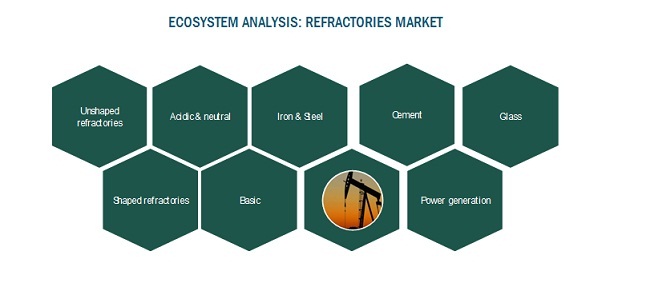
ECOsystem ANALYSIS: Refractories Market
To know about the assumptions considered for the study, download the pdf brochure
Source: Secondary research, primary research, and MarketsandMarkets Analysis
[The Refractories market is projected to register a CAGR of 3.4% during the forecast period, in terms of value."
The global Refractories market is estimated to be USD 23.2 billion in 2020 and is projected to reach USD 27.4 billion by 2025, at a CAGR of 3.4% from 2020 to 2025. The market is witnessing moderate growth, owing to increasing application, technological advancements, and growing demand for these refractories in the Asia Pacific and Europe. Refractories are largely used in the iron & steel industry. The increasing use of refractories and the rising construction activities is driving the refractories market. Strict environmental and government regulations is the restraints for the Refractories market.
[Iron & Steel segment is expected to lead the Refractories market during the forecast period."
The iron & stee; industry will continue to lead the Refractories market, , accounting for a share of 60.0% of the overall market, in 2019 terms of value. This was due to the increasing demand for infrastructure development and mounting demand for consumer goods such as automobiles. The increasing preference for high-cost, high-performance refractories is driven by the need to improve the quality of life, health & environment, and shift to clean, alternative sources of manufacturing.